How to Play Dama (Turkish Draughts): Rules, Captures and Strategy
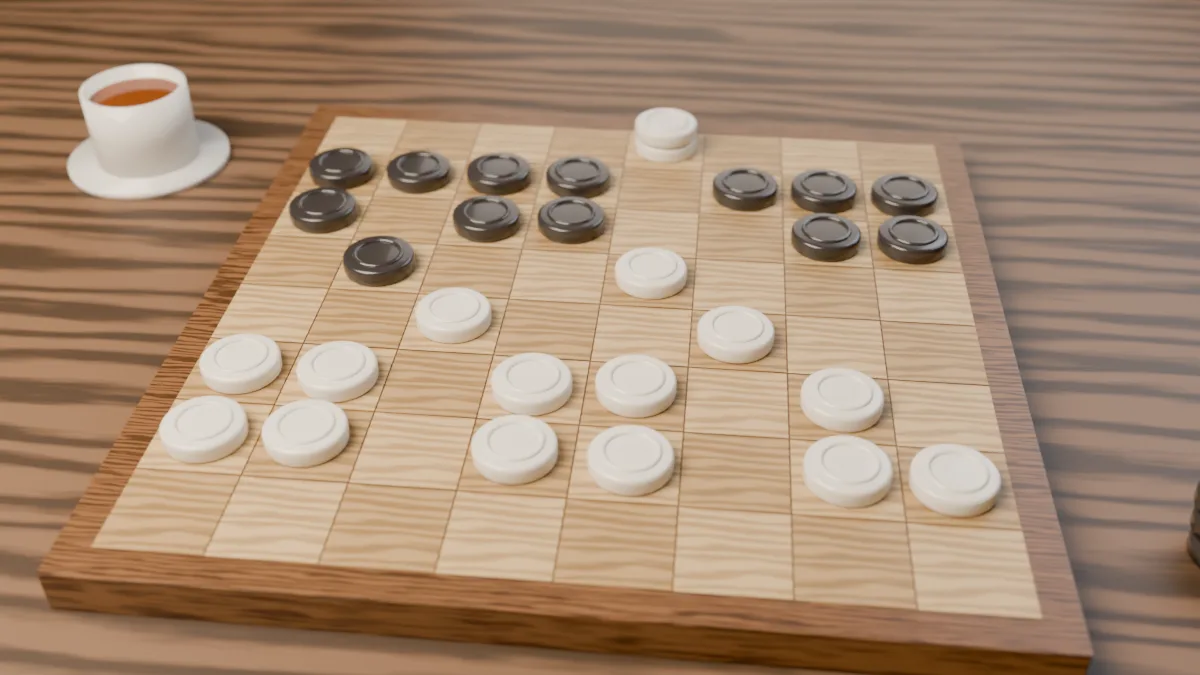
Walk into a café in Kuwait, Riyadh, Damascus or Cairo and you may see two players hunched over a plain wooden board, sweeping rows of pieces off it in a single move. That is Dama, the game known in English as Turkish draughts. It looks like checkers, but it plays very differently. This guide explains how to play Dama step by step, with diagrams, then shares the strategy that wins games.
You can try every rule as you read in our free Dama game online, against the computer or a friend on the same device.
What is Dama?
Dama is the checkers family member played across Turkey, the Levant, the Gulf and Egypt. Unlike English checkers, the pieces move in straight lines, use every square of the board, and capture in long chains that can clear a whole row. Two rules give the game its character: capturing is compulsory, and when you have a choice you must take the largest number of pieces.
The board and the pieces
- A plain 8×8 board. The colour of the squares does not matter, because every square is used.
- 16 men for each player, on the second and third rows from their side. The back rows start empty.
- The lighter side usually moves first. In our game, pink starts.
How the pieces move
A man moves one square straight forward or sideways to an empty square. It never moves diagonally and never moves backwards.
When a man reaches the far row it becomes a dama, a king. A dama is far stronger: it slides any number of empty squares forward, backwards or sideways, like a rook in chess.
Capturing
- A man captures by jumping over an enemy piece that is directly in front of it or beside it, landing on the empty square just beyond. It cannot capture backwards.
- If the man can capture again from its new square, it must keep jumping in the same move.
- Each captured piece is removed as it is jumped, so the same piece can never be taken twice.
- A dama captures from a distance: it can travel along a line, jump over one enemy piece and land on any empty square beyond it, then continue capturing. It may not turn straight back the way it came during the same capture.
The maximum capture rule
This is the rule beginners forget most often. Capturing is compulsory, and if there are several ways to capture you must choose the sequence that takes the most pieces, whether it is made by a man or a dama. If two sequences take the same number, you may choose either.
How to win
You win when your opponent has no pieces left or no legal move. If both players are reduced to a single piece, the game is a draw. Our game also declares a draw when the kings shuffle for a long time without any capture or man move.
7 Dama strategies that win games
- Keep your men together. Pieces side by side and in front of each other protect one another. A lone man in open space is an easy target.
- Count captures for both sides before every move. Because the biggest capture is forced, you can predict exactly how your opponent must answer.
- Use sacrifices. Give up one man to force your opponent onto a square where you take two or three back. This is the heart of advanced Dama.
- Race for the first dama. A flying king controls whole rows and columns. Open a lane on the side of the board and push a protected man through it.
- Do not rush forward alone. A man that runs ahead of the group gets cut off and captured sideways.
- Guard your back row. Keeping a few men near home makes it harder for your opponent to promote.
- In the ending, trade when you are ahead. Every even exchange brings you closer to a winning ending.
Common beginner mistakes
- Moving pieces diagonally, as in ordinary checkers.
- Taking the smaller capture when a bigger one is available.
- Stopping in the middle of a capture chain.
- Forgetting that a dama can capture from far away.
For an independent summary of the rules, see the Turkish draughts rules on Ludoteka.
Frequently asked questions
What is the difference between Dama and checkers?
In Dama the pieces move straight, forward or sideways, and use every square of the board. In ordinary checkers they move diagonally on the dark squares only. Dama also has 16 men a side instead of 12 and forces you to take the largest capture.
Is capturing compulsory in Dama?
Yes. If you can capture you must, and if several captures are possible you must choose the one that takes the most pieces.
Can a man capture backwards?
No. A man captures forward or sideways only. Only a dama (king) can move and capture backwards.
How does a piece become a dama?
When a man reaches the last row on the opponent's side, it is promoted to a dama at the end of the move.
How do you win at Dama?
Capture all your opponent's pieces or leave them with no legal move. If each player has only one piece left, the game is a draw.
Where can I play Dama online for free?
You can play Dama free on PlayNovarc against an easy or hard computer, or with a friend on the same device, with no download.
Play Dama now
Open our free Dama game, start on Easy to get used to straight moves and forced captures, then challenge the Hard computer. Prefer the diagonal version? Try Checkers, or explore all our free board games.