How to Win at Minesweeper: Patterns Every Player Should Know
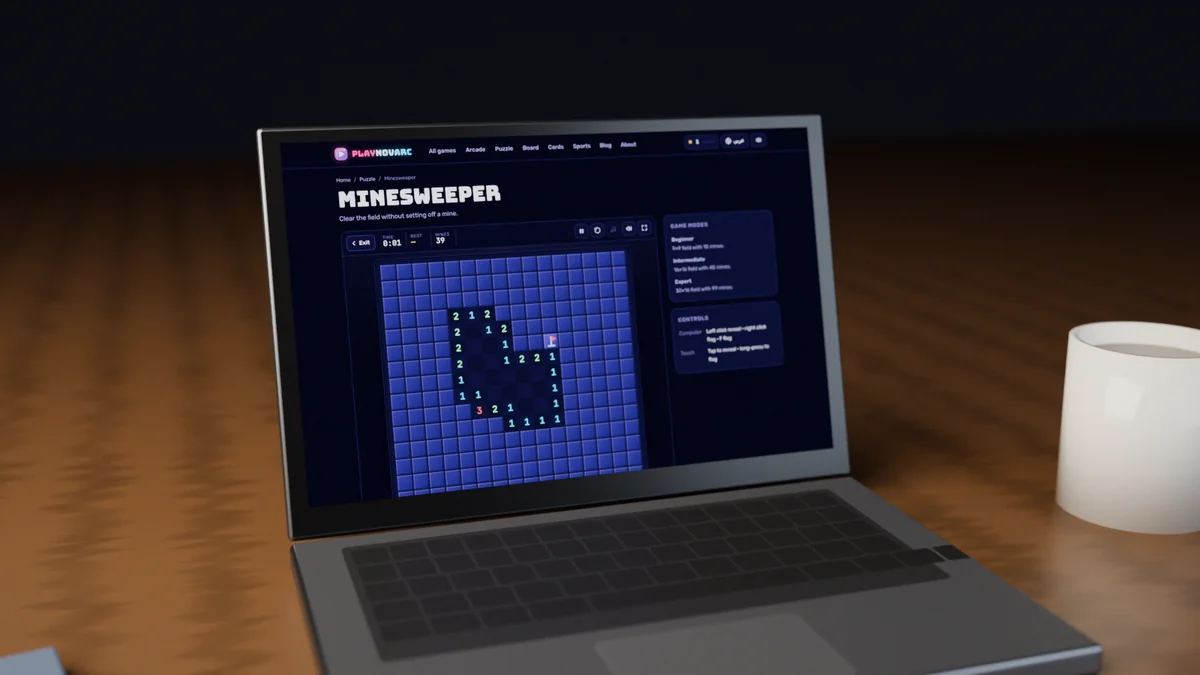
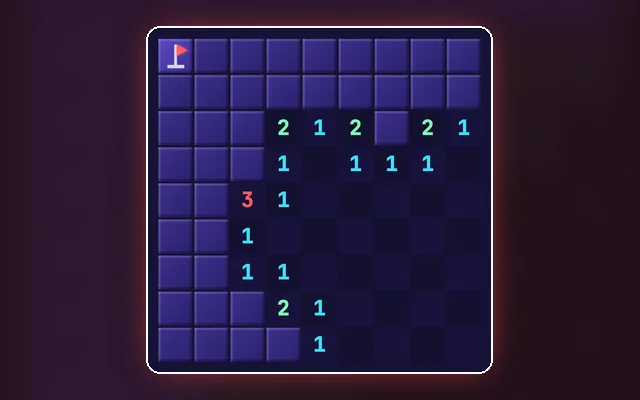
Minesweeper looks like a game of luck until you learn to read it. Behind every number is a small logic puzzle, and once you recognise a handful of patterns, most of the board solves itself. This guide explains how to play Minesweeper, then walks you through the Minesweeper strategy that experienced players use to clear Expert boards: the key patterns, when a guess is unavoidable, and how to get faster.
Keep our free online Minesweeper game open in another tab and try each pattern as you read. It runs in your browser on phone or computer, and your first click is always safe.
Minesweeper rules in brief
The board is a grid of covered squares with a fixed number of mines hidden underneath. Click (or tap) a square to reveal it:
- If it is a mine, the game is over.
- If it shows a number, that number is how many mines are in the eight squares around it (up, down, left, right and the four diagonals).
- If it is blank, none of its neighbours is a mine, and they all open automatically.
Right-click, long-press or switch to Flag mode to place a flag on a square you know is a mine. You win when every safe square has been revealed. In our version your first click is always safe and opens an area to start from.
How to read the numbers
Every Minesweeper deduction comes from two simple questions about a number:
- Are all its mines already found? If a 2 already touches two flags, every other covered square around it is safe.
- Is the number equal to its covered neighbours? If a 2 touches exactly two covered squares, both must be mines.
When neither answer is clear for a single number, look at two neighbouring numbers together. That is where the famous patterns come from.
7 Minesweeper patterns every player should know
1. The obvious mines
A number with exactly that many covered neighbours points straight at its mines. The most common case is a 1 in a corner of an opened area that touches a single covered square: that square is a mine.
2. The satisfied number (chording)
When a number already touches as many flags as its value, all its other covered neighbours are safe. Instead of clicking them one by one, click the number itself to open them all at once. This is called chording, and it is the single biggest speed boost in Minesweeper.
3. The 1-1 from a wall
When two 1s sit side by side along the edge of the board (or against an opened area), starting at the wall, they share the same mine among the first two covered squares. The covered square beyond the second 1 is therefore safe.
4. The 1-2
Along a straight line of numbers, if a 1 is followed by a 2, the covered square that only the 2 touches, on the far side from the 1, must be a mine. The 1 can account for at most one of the 2's mines, so the other must be the one beyond.
5. The 1-2-1
On a straight edge, a 1-2-1 always has its mines under the two 1s, and the square under the 2 is safe. Once you recognise it, you can flag two mines and open one square without thinking.
6. The 1-2-2-1
On a straight edge, a 1-2-2-1 has its mines under the two 2s, and the squares under the two 1s are safe. In practice, the 1-2-1 and 1-2-2-1 are just the 1-2 pattern applied from both ends.
7. Reduction (subtracting known mines)
Many hard positions become simple once you subtract flags you already know. A 3 that touches one flag behaves like a 2 for its remaining covered squares; a 2 with one flag behaves like a 1. Mentally "reduce" the numbers, and the basic patterns above appear again.
When you have to guess
Some positions cannot be solved by logic. Two squares with equal chances, a classic 50/50, are part of the game. Good players reduce the damage:
- Guess early, not late. Losing on a guess after five minutes of work hurts far more than losing in the first ten seconds.
- Prefer a guess that opens information. A square that could reveal a blank, often in a corner or along an edge, is worth more than one that only confirms a single number.
- Use the overall mine density when nothing else helps:
| Level | Board | Mines | Chance a random square is a mine |
|---|---|---|---|
| Beginner | 9 × 9 | 10 | about 12% |
| Intermediate | 16 × 16 | 40 | about 16% |
| Expert | 30 × 16 | 99 | about 21% |
If a local number gives a square a higher chance than the board average, a random square elsewhere may be the safer click.
How to play Minesweeper faster
- Chord everything. Clicking a satisfied number opens several squares at once.
- Work one area at a time. Finish the edge you are on before jumping across the board.
- Flag only when it helps. Flags you never chord around cost time; many top players flag very little.
- Keep your mouse movements short. Plan the next few clicks so your hand travels less.
- Practise the patterns. Speed comes from recognising 1-2-1 and 1-2-2-1 instantly, not from clicking faster.
Common Minesweeper mistakes
- Clicking a square "because it feels safe" when the numbers say otherwise.
- Forgetting the diagonal neighbours when counting.
- Leaving a forced guess until the very end of the game.
- Placing a wrong flag, then chording around it. Always double-check a flag before you chord.
A short history of Minesweeper
Minesweeper became one of the most familiar computer games in the world after Microsoft included it in Windows 3.1 in 1992, where it quietly taught a generation to right-click. Behind the simple rules is serious mathematics: in 2000, mathematician Richard Kaye showed that the general Minesweeper consistency problem is NP-complete, linking the game to one of the biggest open questions in computer science (Kaye, Minesweeper is NP-complete).
Frequently asked questions
Is Minesweeper a game of luck or skill?
Mostly skill. The large majority of moves can be deduced with logic; luck only decides the occasional forced guess.
Is the first click always safe?
In our game, yes. The board is generated after your first click so that square and its neighbours contain no mines.
What is the best first move?
Since the first click is safe, click near the middle to open a large area. In versions without a safe start, corners are more likely to open a blank region.
How do I flag a mine on a phone?
Long-press the square, or switch to Flag mode and tap.
What does chording mean?
Chording means clicking a revealed number whose mines are all flagged, which opens all its other neighbours in one move.
Put it into practice
Open Minesweeper on PlayNovarc, start on Beginner, and say each pattern out loud as you spot it. When you can clear Beginner without a single guess, move up to Intermediate and then Expert. If you enjoy logic puzzles, also try Sudoku, read our guide to Sudoku techniques for beginners, play Nonogram or the hunting game Sea Battle, or browse all puzzle games.