Sudoku for Beginners: 7 Solving Techniques That Always Work
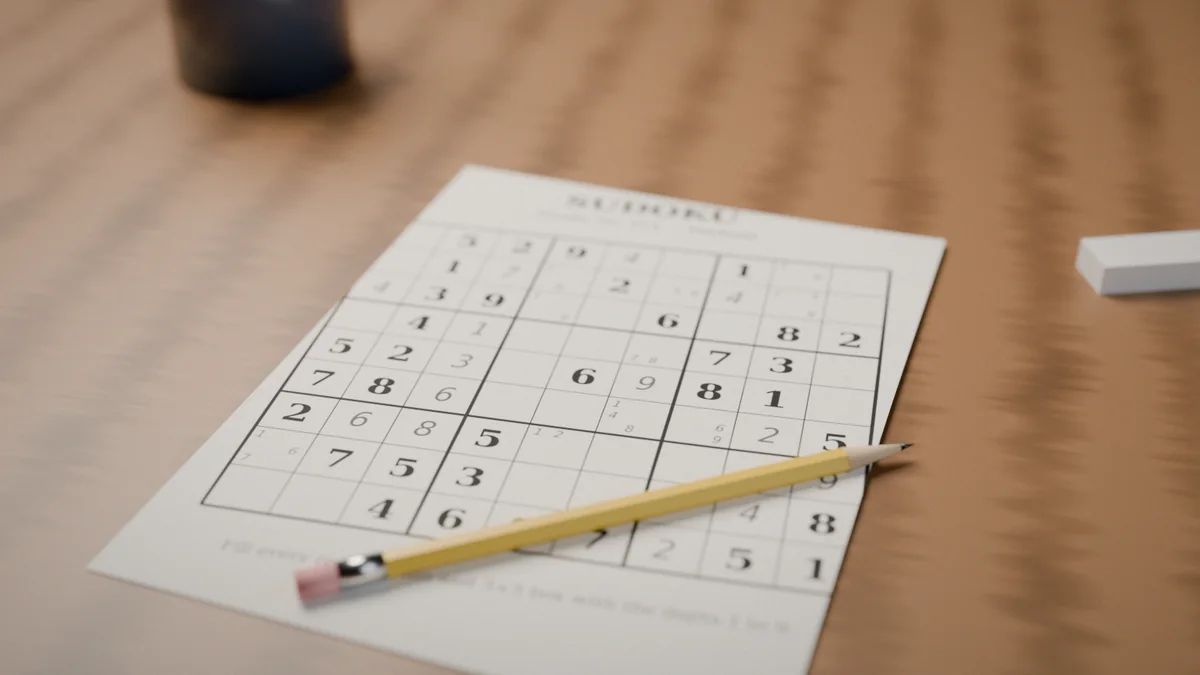
Sudoku looks like a maths puzzle, but it is really a game of pure logic. You never add or multiply anything, and you never need to guess. If you have ever stared at a grid and not known where to start, this guide is for you. You will learn how to solve Sudoku with seven techniques, from the simple scan every beginner should master to the X-Wing pattern that cracks hard puzzles.
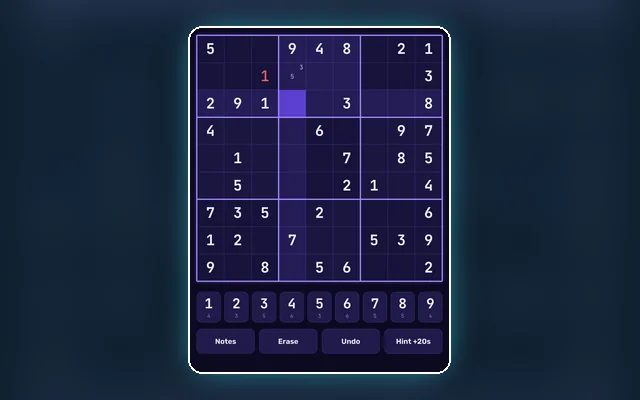
You can practise every technique as you read in our free online Sudoku game. It has four difficulty levels, notes, hints and undo, and it works on any phone or computer.
Sudoku rules in one minute
A Sudoku grid has 81 cells, arranged in nine rows, nine columns and nine 3×3 boxes. Some cells contain given numbers, called clues. Your job is to fill every empty cell with a digit from 1 to 9 so that:
- each row contains every digit from 1 to 9 exactly once,
- each column contains every digit from 1 to 9 exactly once,
- each 3×3 box contains every digit from 1 to 9 exactly once.
A properly made puzzle has exactly one solution. That is why logic always works: every correct digit can be proved from the clues.
The 7 Sudoku techniques every beginner should know
1. Cross-hatching (scanning)
Pick one digit, for example 5, and choose a box that does not have a 5 yet. Look along the rows and columns that pass through that box. Every row and column that already contains a 5 elsewhere is ruled out. Often only one cell in the box is left, and the 5 must go there.
Scanning is the fastest technique in Sudoku. Work through the digits 1 to 9 and every box once before you move on; it solves a surprising number of cells.
2. Naked single (counting)
Now look at one empty cell instead of one digit. Check which digits already appear in its row, its column and its box. If eight different digits are already present, the missing ninth digit is the only one that can go in that cell. This is called a naked single.
3. Hidden single
Sometimes a cell could hold several digits, but one of those digits fits nowhere else in its row, column or box. Then that cell must hold it, even though other candidates seem possible. Hidden singles are the most common way intermediate puzzles move forward, so check each row, column and box for digits with only one possible home.
4. Pencil marks (candidates)
When scanning stops working, write the possible digits in small numbers in the corner of each empty cell. These are called candidates or notes. In our game, press the Notes button or the N key. Notes turn a mental puzzle into a visible one, and they make the next three techniques possible. Always update them: when you place a digit, remove it from the notes in the same row, column and box.
5. Naked pairs (and triples)
If two cells in the same row, column or box both contain exactly the same two candidates, for example {3, 7}, then those two digits must go in those two cells. You do not know which is which yet, but you can remove 3 and 7 from every other cell in that unit. The same logic works for three cells sharing three candidates: a naked triple.
6. Pointing pairs (locked candidates)
Look inside one box. If every possible position for a digit in that box lies on the same row, the digit must end up in that row within the box. That means you can remove it from the rest of that row, outside the box. The same applies to columns. This simple pattern unlocks many Hard puzzles.
7. X-Wing
X-Wing is the first "advanced" pattern. Find a digit that has exactly two possible cells in one row, and exactly two possible cells in another row, in the same two columns. The four cells form a rectangle. The digit must sit in two opposite corners, so it is guaranteed to occupy both columns. You can remove it from every other cell in those two columns. The same works with columns and rows swapped.
| Technique | Level | What it finds |
|---|---|---|
| Cross-hatching | Beginner | The only cell in a box for a digit |
| Naked single | Beginner | The only digit for a cell |
| Hidden single | Beginner to intermediate | A digit with one home in a row, column or box |
| Pencil marks | Intermediate | All candidates, made visible |
| Naked pairs and triples | Intermediate | Candidates you can remove from a unit |
| Pointing pairs | Intermediate to hard | Candidates you can remove outside a box |
| X-Wing | Hard to expert | Candidates you can remove across two columns or rows |
A simple routine for solving any Sudoku
- Scan every digit from 1 to 9 across all nine boxes.
- Check each row, column and box for hidden singles.
- When progress stops, fill in notes for every empty cell.
- Look for naked pairs and pointing pairs, and clean up your notes.
- After each new digit, go back to step 1: one placement often unlocks several more.
- Only when everything else fails, look for an X-Wing.
Common Sudoku mistakes
- Guessing. One wrong guess can quietly spoil the whole grid and you will only notice much later.
- Forgetting the box. Beginners often check the row and column but forget the 3×3 box.
- Stale notes. Notes that are not updated lead to "impossible" situations that are really just bookkeeping errors.
- Jumping around. Working systematically, digit by digit, is faster than hunting at random.
Which difficulty should you play?
Our Sudoku game has four levels. Easy gives 40 clues and can be solved by scanning alone. Medium gives 33 clues and needs hidden singles. Hard gives 28 clues, where notes and pairs become essential. Expert removes as many clues as the puzzle allows. Move up one level when you can finish the current one without hints.
Sudoku facts worth knowing
- The modern puzzle first appeared in 1979 in an American puzzle magazine under the name Number Place, created by Howard Garns.
- The Japanese publisher Nikoli gave it the name Sudoku in the 1980s, and it became a worldwide craze in 2004 and 2005 after British newspapers began printing it.
- There are about 6.67 sextillion (6.67 × 10²¹) possible completed Sudoku grids.
- A classic Sudoku needs at least 17 clues to have a single solution. Researchers proved in 2012, after an exhaustive computer search, that no 16-clue puzzle exists (McGuire, Tugemann and Civario).
Frequently asked questions
Do you need to be good at maths to play Sudoku?
No. The digits are only symbols; you could play with letters or colours. Sudoku is about logic and attention, not arithmetic.
Is it ever necessary to guess?
Not in a well-made puzzle. Every puzzle with a unique solution can be solved by logic, although the hardest ones need advanced patterns.
How long does it take to solve a Sudoku?
An Easy puzzle often takes 5 to 15 minutes for a beginner. Hard and Expert puzzles can take much longer. Speed comes naturally as scanning becomes automatic.
Is Sudoku good for your brain?
Sudoku exercises logical reasoning, concentration and working memory, and many people find it relaxing. Like any puzzle, it is a pleasant mental workout rather than a medical treatment.
Where can I play Sudoku for free?
Right here: our free Sudoku game runs in your browser with no download. If you enjoy logic puzzles, also try Nonogram, Minesweeper or browse all our puzzle games.
Start solving
Open Sudoku on PlayNovarc, choose Easy, and use only cross-hatching for your first puzzle. Then switch on notes for a Medium grid and hunt for a naked pair. Within a few games, these techniques will feel automatic.