2048 Strategy: The Corner Method to Reach the 2048 Tile

2048 takes ten seconds to learn: slide the tiles, merge equal numbers, and try to build a 2048 tile. Yet most players get stuck around 256 or 512. The difference between a stuck board and a winning one is almost always the same thing: where your biggest tile lives. This guide explains the 2048 corner strategy step by step, so you can reach the 2048 tile reliably and then keep going.
Follow along in our free online 2048 game, which works with swipes on a phone and arrow keys on a computer.
How 2048 works
The game is played on a 4×4 grid. Every move slides all tiles as far as possible in one direction. When two tiles with the same number collide, they merge into one tile with their sum: 2 + 2 = 4, 4 + 4 = 8, and so on, doubling all the way to 2048. After each move a new tile appears in a random empty cell, usually a 2 and sometimes a 4. Your score grows by the value of every merged tile, and the game ends when the board is full and no merge is possible.
2048 was created by Italian developer Gabriele Cirulli in 2014 as a weekend project and released as open source. It went viral within days and remains one of the most played puzzle games in the world.
The corner method, step by step
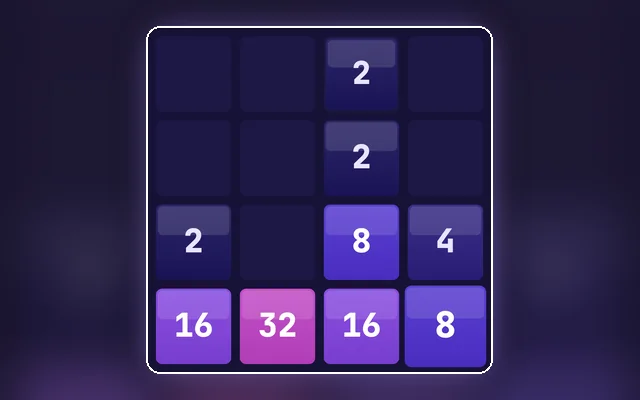
Good: biggest tile locked in the corner, a descending snake
Bad: big tiles scattered in the middle
- Choose your corner. Any corner works; this guide uses bottom-left. Your biggest tile should sit there for the entire game.
- Pick two main directions. With a bottom-left corner, press Down and Left for most moves. These two always push tiles toward the corner.
- Use Right as your third move. When Down and Left do nothing, press Right. Your bottom row stays in place as long as it is full.
- Avoid Up. Pressing Up can lift your biggest tile out of the corner and let a small tile slip under it. Use it only when it is the only legal move.
- Keep the bottom row full. A full row cannot slide sideways, so your corner tile is locked in place even when you press Right.
- Build a snake. Arrange the bottom row in descending order away from the corner (for example 512, 256, 128, 64), then continue up and back along the next row. When the smallest end of the chain merges, every tile can collapse into the corner in a cascade.
Seven tips that make the corner method work
- Merge small tiles early. Loose 2s and 4s fill the board fast. Combine them before they spread.
- Think about where the new tile will appear. After your move a tile spawns in an empty cell. Avoid moves that open the space under or beside your corner tile.
- Feed the chain from its smallest end. Build the next number next to the end of your snake, not on the far side of the board.
- Do not chase merges far away. A merge on the opposite side often costs you the structure that makes the next ten merges possible.
- Keep one column for building. The column above your corner is where you prepare tiles to drop into the snake.
- Slow down at 512. Around 512 and 1024 the board gets tight. Look two moves ahead before every swipe.
- Use the board's edges. Tiles along the bottom and left are easier to control than tiles floating in the middle.
What to do when it goes wrong
Sooner or later a 2 will land in your corner, usually after a forced Up. Do not panic:
- Fill the gap again as quickly as possible by pressing Down and Left until your big tile slides back.
- If the small tile is stuck in the corner, start building a new chain from that tile and merge it up until it can join the old structure.
- If your big tile ends up in a different corner, consider adopting that corner instead of fighting to move it back.
Strategy for every mode
| Mode | Board and goal | What changes |
|---|---|---|
| Classic 4×4 | 4×4, reach 2048 | The corner method exactly as described above. |
| Big 5×5 | 5×5, reach 2048 | More room for mistakes. Build a longer snake along two full rows; scores can go much higher. |
| Mini 3×3 | 3×3, reach 256 | Very little space. Every move counts, so merge immediately and never leave the corner row half empty. |
| Time Attack | 4×4, 3 minutes | Speed beats perfection. Keep the corner idea, but make fast, safe merges instead of long plans. |
Common 2048 mistakes
- Swiping in all four directions at random.
- Pressing Up "just once" and losing the corner.
- Leaving the bottom row with a gap that lets tiles slide.
- Building two large tiles in different corners that can never meet.
- Ignoring small tiles until they block the whole board.
Frequently asked questions
Is 2048 luck or skill?
Mostly skill. The new tiles are random, but a good strategy keeps the board flexible enough to absorb bad luck. Players who use the corner method reach 2048 far more often.
What is the best corner in 2048?
No corner is better than another; the board is symmetric. What matters is choosing one and staying with it.
Can you keep playing after reaching 2048?
Yes. In our game you see a "Keep going" message and can continue toward 4096, 8192 and beyond for a higher score.
What is the highest possible tile?
On a 4×4 board, the largest tile that can theoretically be built is 131,072, although reaching even 8,192 is a serious achievement.
How is the 2048 score calculated?
Every merge adds the value of the new tile, so merging two 64s adds 128 points.
Try the corner method now
Open 2048 on PlayNovarc, choose Classic 4×4, and play one game using only Down and Left whenever possible. You will feel the board become calmer within a few minutes. When you want a new challenge, try the 5×5 and 3×3 boards, the Slide Puzzle, or our guide to Sudoku techniques for beginners. You can also browse every puzzle game.