How to Set Up Solitaire: Step-by-Step Card Layout Guide (with Pictures)
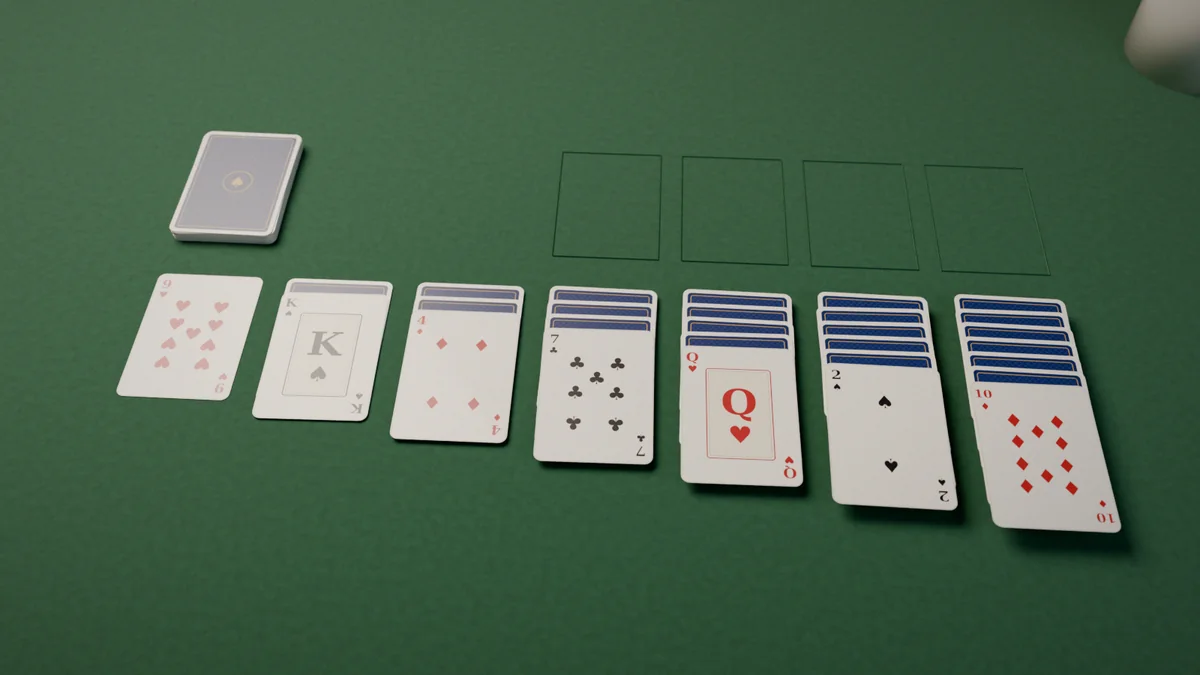
You have a deck of cards and want to play Solitaire, but how exactly do the cards go down? This guide shows you how to set up Solitaire step by step, with pictures of each stage, so your layout matches the classic game every time. It covers the standard Klondike Solitaire setup, quick checks to make sure you dealt correctly, and the layouts for FreeCell and Spider.
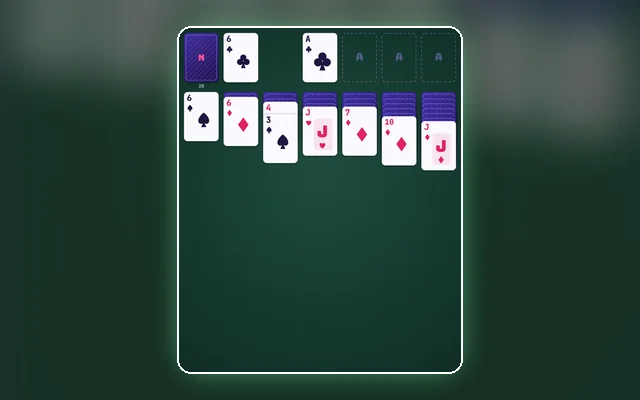
Don't have cards nearby? Our free online Solitaire game deals the layout for you instantly, on phone or computer, with no download.
What you need
- One standard deck of 52 playing cards, with the jokers removed.
- A flat table with room for seven columns side by side, plus a row above them.
- About two minutes. Once you have done it a few times, setting up takes less than a minute.
The four areas of a Solitaire layout
| Area | Where it goes | Cards at the start |
|---|---|---|
| Tableau | Seven columns across the middle | 28 cards (1, 2, 3, 4, 5, 6 and 7) |
| Stock | Top left, face down | 24 cards |
| Waste | Next to the stock | Empty |
| Foundations | Top right, four spaces | Empty |
How to set up Solitaire, step by step
- Shuffle the deck well. A few quick overhand shuffles leave cards in clumps. Mathematicians have shown that about seven riffle shuffles are needed to mix a 52-card deck properly (Seven Shuffles, Harvey Mudd College).
- Deal round 1. Place one card face up to start column 1. Then, moving right, place one card face down in each of columns 2 to 7.
- Deal round 2. Skip column 1. Place one card face up on column 2, then one card face down on each of columns 3 to 7.
- Keep going. In each new round, start one column further to the right: the first card of the round goes face up, the rest go face down.
- Finish with round 7. The last round is a single face-up card on column 7.
- Place the stock. Put the remaining 24 cards face down in a pile at the top left.
- Leave space next to the stock for the waste pile, and four spaces at the top right for the foundations.
Check your layout in 10 seconds
- Column 1 has 1 card, column 7 has 7: 28 cards in total.
- Exactly 7 cards are face up, one at the bottom of each column.
- The stock has 24 cards. If you have 23 or 25, a card went to the wrong column.
- No jokers, and every column overlaps so the face-down cards stay hidden.
Draw 1 or Draw 3?
The setup is the same for both. The difference is how you play the stock: in Draw 1 you turn one card at a time onto the waste; in Draw 3 you turn three and may only play the top one. Draw 1 is easier for beginners, and Draw 3 is the traditional challenge. Our Solitaire game offers both, plus a 5-minute Rush mode.
Common setup mistakes
- Dealing column by column instead of in rounds. It gives the same counts, but dealing in rounds is the traditional method and makes it easy to keep track of where you are.
- Turning up the wrong cards. Only the last card dealt to each column is face up.
- Forgetting the foundations. Leave the four spaces empty; Aces go there during play, not during the deal.
- Playing before you finish dealing. Complete all seven rounds first, then look for moves.
How to set up FreeCell
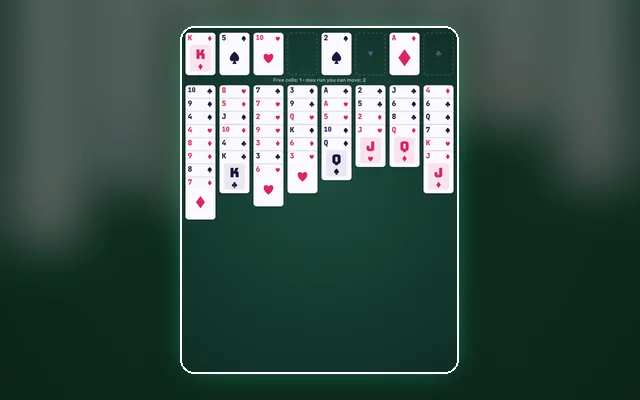
FreeCell uses one 52-card deck, and every card is dealt face up into eight columns. Deal across the eight columns in rounds until the deck is gone: the first four columns get 7 cards each and the last four get 6 cards. Above them leave four free cells (temporary single-card spaces) and four foundations. There is no stock. Try it in our free FreeCell game.
How to set up Spider Solitaire
Spider uses two decks (104 cards) and ten columns. Deal 54 cards so that the first four columns have 6 cards and the other six columns have 5 cards, with only the top card of each column face up. The remaining 50 cards form the stock, which is dealt out ten at a time, one card on each column, whenever you are stuck.
| Game | Decks | Columns | Cards per column | Stock |
|---|---|---|---|---|
| Klondike Solitaire | 1 | 7 | 1 to 7 (28 total) | 24 cards |
| FreeCell | 1 | 8 | 7, 7, 7, 7, 6, 6, 6, 6 | None (4 free cells) |
| Spider | 2 | 10 | 6 × 4 columns, 5 × 6 columns | 50 cards |
Frequently asked questions
How many cards go in each column in Solitaire?
From left to right: 1, 2, 3, 4, 5, 6 and 7 cards, which makes 28 cards in the tableau.
How many cards are left in the stock?
24 cards, placed face down at the top left.
Which cards are face up at the start?
Only the top (last dealt) card of each of the seven columns: seven face-up cards in total.
Do you use jokers in Solitaire?
No. Remove both jokers; Klondike Solitaire uses exactly 52 cards.
Where do the Aces go?
Nowhere at the start. During play, move each Ace to an empty foundation space as soon as it appears, and build that suit up to the King.
Next step: learn to play
Once your cards are on the table, read our complete guide on how to play Solitaire for the rules, scoring and ten tips to win more games. Or skip the shuffling altogether and play Solitaire online for free, with hints, undo and auto-finish. You can also browse all our card games.