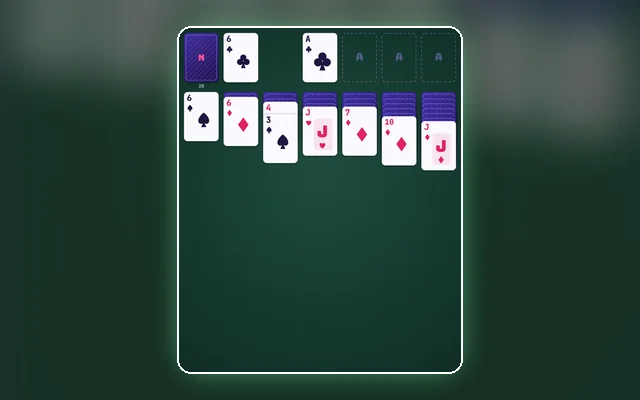
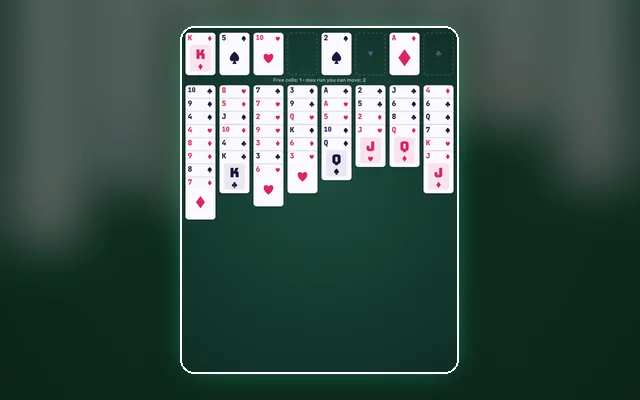
How to Play Solitaire: Rules, Setup and Tips to Win More Games
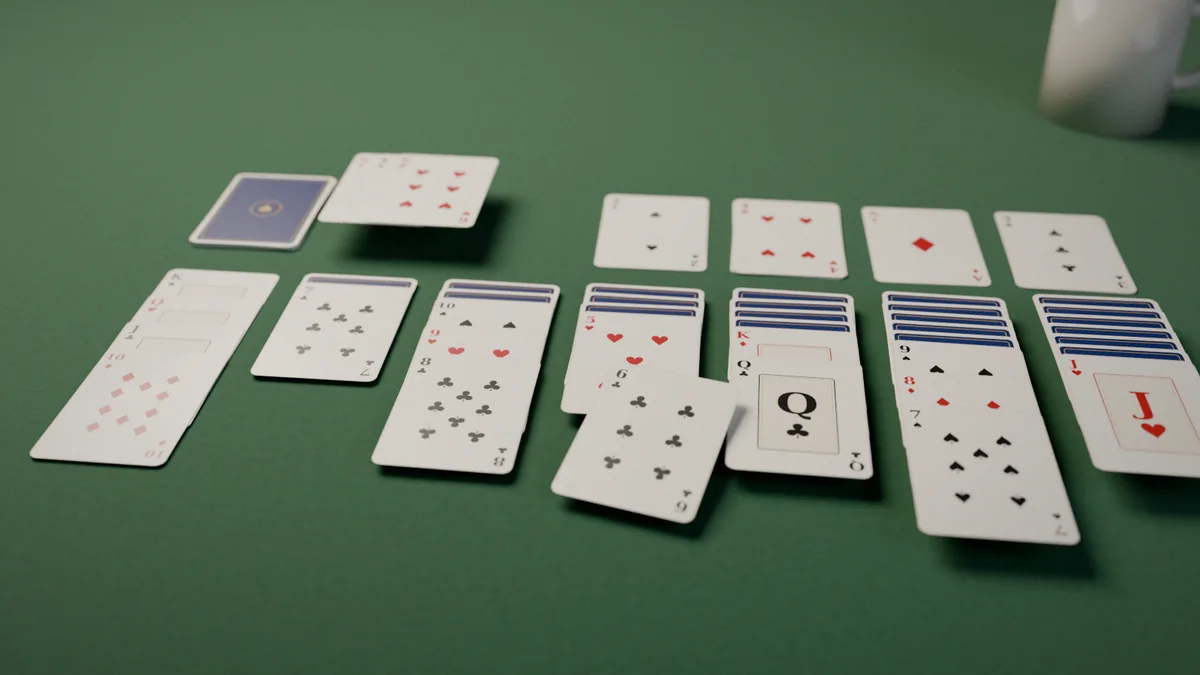
Solitaire is the most played card game in the world, and for good reason: you need nothing but a deck of cards, the rules fit on one page, and every deal is a small puzzle with a satisfying finish. This guide explains how to play Solitaire from the very first card, covers every rule of the classic Klondike version, and then gives you ten practical tips that will noticeably raise your win rate.
You can follow along in our free online Solitaire game: it runs in your browser on phone or computer, with no download and no sign-up.
What is Klondike Solitaire?
When people say "Solitaire" they almost always mean Klondike Solitaire, the version that came pre-installed on Windows computers for decades. It is a single-player "patience" game played with a standard 52-card deck and no jokers. The goal is simple to state and surprisingly deep to master: move every card onto four foundation piles, one per suit, in order from Ace to King.
Other famous patience games, such as FreeCell, Spider and Pyramid, use different layouts and rules. Mahjong Solitaire is not a card game at all but a tile-matching puzzle; you can try it in our Mahjong Tiles game.
How to set up Solitaire: the four areas of the table
A Klondike deal is always set up the same way. Shuffle the deck, then lay out the cards in four areas:
| Area | Cards at the start | What it is for |
|---|---|---|
| Tableau | 28 cards in 7 columns (1 to 7 cards) | The main playing area where you build descending sequences |
| Stock | The remaining 24 cards, face down | Your reserve; you draw from it when you need new cards |
| Waste | Empty | Cards drawn from the stock land here face up; only the top one can be played |
| Foundations | Empty (4 spaces) | Where you build each suit from Ace to King; filling all four wins the game |
To deal the tableau, place one card face up in the first column, then one card face down in each of the other six. Next, place a face-up card on the second column and face-down cards on columns three to seven, and so on. When you finish, column one holds one card and column seven holds seven, with only the last card of each column turned face up. For a full picture-by-picture walkthrough, including FreeCell and Spider layouts, read our guide on how to set up Solitaire step by step.
Solitaire rules: every move you are allowed to make
- Build down in alternating colours. In the tableau, a card can be placed on another card that is one rank higher and of the opposite colour. A red 9 goes on a black 10; a black 6 goes on a red 7.
- Move whole sequences. You can move a correctly ordered run of face-up cards (for example red 8, black 7, red 6) together, as long as its top card fits the destination.
- Turn over hidden cards. When you move the last face-up card off a column, flip the face-down card underneath. Uncovering these hidden cards is the heart of the game.
- Only Kings fill empty columns. An empty tableau column can be filled only by a King, or by a sequence that starts with a King.
- Build foundations up by suit. Each foundation starts with an Ace and continues 2, 3, 4 and so on up to King, all in the same suit.
- Draw from the stock. When you have no useful move, turn cards from the stock onto the waste. The top waste card can be played to the tableau or a foundation.
- Recycle the waste. When the stock runs out, turn the waste pile over to form a new stock. Some rule sets limit how many times you may do this; casual games usually allow unlimited passes, often with a score penalty.
Draw 1 vs Draw 3: which should you play?
The single most important setting in Solitaire is how many cards you turn from the stock at a time.
| Draw 1 | Draw 3 | |
|---|---|---|
| Cards turned per draw | One | Three (only the top one is playable) |
| Difficulty | Easier, good for learning | Harder, needs planning |
| Access to the stock | Every card is reachable on each pass | Only every third card is reachable until the order shifts |
| Best for | Beginners and relaxed games | Players who want a real challenge |
If you are new to the game, start with Draw 1. Once you win it regularly, switch to Draw 3, which is the traditional "classic" setting.
How Solitaire scoring works
Many versions of Solitaire, including ours, use the familiar standard scoring system. Points reward progress and punish wasted effort:
| Action | Points |
|---|---|
| Move a card to a foundation | +10 |
| Move a card from the waste to the tableau | +5 |
| Turn over a face-down tableau card | +5 |
| Move a card back from a foundation to the tableau | −15 |
| Undo a move | −5 |
| Recycle the waste into the stock | −100 in Draw 1, −20 in Draw 3 |
| Win the game | Time bonus: the faster you finish, the bigger it is |
10 tips to win more Solitaire games
Luck decides the deal, but skill decides most of the result. Experienced players follow a few simple habits:
- Always look for a hidden card to uncover first. Before drawing from the stock, check every move that would flip a face-down tableau card. New information is worth more than anything else.
- Work on the longest columns. The columns on the right hide up to six cards. Freeing them early opens far more options than clearing a short column.
- Play Aces and Twos immediately. They can never help you in the tableau, so send them to the foundations as soon as they appear.
- Do not rush other cards to the foundations. A black 5 in the tableau may be the only place to put a red 4 later. Keep middle cards in play until you are sure you will not need them.
- Do not empty a column without a King ready. An empty column is only useful if you have a King, ideally one with cards hidden beneath it, waiting to move into it.
- Choose your King carefully. If both a red and a black King could fill a space, look at which Queen and Jack are available. Pick the King that lets you continue a sequence.
- Keep your colours balanced. When two cards can make the same move, choose the one that keeps both red and black cards free to build on.
- Use the stock with a plan. In Draw 3, think about how playing the top waste card changes which cards you will see on the next pass.
- Use undo to learn, not to cheat yourself. Undo is perfect for testing two possible lines. Notice why one worked, and you will spot it next time without help.
- Accept that some deals cannot be won. Researchers who analysed millions of deals found that about 82% of Klondike games can be won by a player who could see every card (Blake and Gent, The Winnability of Klondike Solitaire). With hidden cards, real win rates are lower. If a game is stuck, start a new one.
Common Solitaire mistakes to avoid
- Drawing from the stock before checking the tableau for moves.
- Moving cards just because a move is possible, without a reason.
- Emptying a column with no King to place there.
- Sending every card to the foundations too early and getting blocked.
- Forgetting that whole sequences can move together.
How to play Solitaire online on PlayNovarc
Our free Solitaire game follows the Klondike rules in this guide and adds a few features that make it comfortable on any device:
- Three modes: Draw 1, Draw 3, and a 5-Minute Rush where you score as much as you can before time runs out.
- Tap to move: on a phone, tap a card and it jumps to the best legal spot. On a computer you can also drag and drop.
- Hints and undo: press the Hint button (or H) when you are stuck, and Undo (or Ctrl+Z) to take a move back.
- Auto-finish: once every card is face up and the stock is empty, the game completes the foundations for you.
- Saved records: your best score in each mode is stored on your device, along with your level and medals.
When you are ready for a tougher patience game, try FreeCell, or browse all our card games.
A short history of Solitaire
Patience games appear in European books from the late 18th and 19th centuries. The Klondike version is often linked to the Klondike Gold Rush in Canada's Yukon in the 1890s, although its exact origin is uncertain. The game reached a huge new audience in 1990, when Microsoft included Solitaire in Windows 3.0. It was designed partly to teach people how to use a mouse by dragging and dropping cards, and it went on to become one of the most played computer games ever.
Frequently asked questions
Is every game of Solitaire winnable?
No. Some deals are impossible no matter how well you play. Studies estimate that roughly four out of five deals could be won if you could see every card, and fewer in practice because the cards are hidden.
Can you move cards from the foundation back to the tableau?
Yes, in most versions, including ours. It can help you place a card of the opposite colour, but it costs 15 points.
How do you set up Solitaire?
Deal 28 cards into seven columns, from one card in the first column to seven in the last, with only the top card of each column face up. Place the remaining 24 cards face down as the stock, and leave room for the waste pile and four foundations.
What can go in an empty column?
Only a King, or a sequence of cards that starts with a King.
What is the difference between Solitaire and FreeCell?
In FreeCell all cards are dealt face up and you get four free cells to store cards temporarily, so almost every deal can be solved with careful planning. Klondike has hidden cards and a stock, so luck plays a bigger role.
Can I play Solitaire for free without downloading?
Yes. Our Solitaire game is free and opens instantly in your browser on phones, tablets and computers.
Ready to deal?
Open Solitaire on PlayNovarc, start with Draw 1, and use the first three tips on every move: look for hidden cards, work on long columns, and play your Aces at once. You will feel the difference within a few games.